Thursday, August 14, 2008

Freebase Parallax Taunts Us With Awesome Semantic Web Video

Staff researcher David François Huynh has created an interesting tool for browsing semantic database Freebase, called Freebase Parallax. Written up by ZDNet's Oliver Marks, the video Huynh recorded demonstrating Parallax (below) will knock your socks off.

Unfortunately, actually using Parallax demonstrates just how far
from solid Freebase, one of the semantic web's poster children, really
is. The idea is to allow you to apply multiple filters for your
searches and embed live charts in a blog. It's a beautiful idea, check
out the video.


Here's the video below, if you find yourself saying "get to the point already," then skip to about 1:30 in the timeline.


Freebase Parallax: A new way to browse and explore data from David Huynh on Vimeo.


Unfortunately, when we tried out a number of searches in Parallax,
very few subjects were well populated at all. We found duplicate
subject titles where one held solid data and the other didn't, but even
that was a best case scenario. In search after search, we found next to
nothing in Freebase.


The example above is nice, but let's say I want to find out
something about black women scientists. No luck. History of the
internet? Not much information there. Venture Capitalists? Blank
profile pages.


This ought to work. Freebase has taken more than
$50 million in venture investments, they have a small army of volunteer
and computer scientist contributors, they've got robots pumping their
database with information automatically. There are now 60% more articles in Freebase than there are in English Wikipedia. So what's the problem?


We wrote last week about ontological concerns about the semantic web,
but Parallax shows that there are more superficial problems. An
unfriendly UI has been Freebase's excuse for a long time, despite
recent improvements to it. We love the idea of the semantic web, but
give it's grand daddy website a usable UI like Parallax and we're left
questioning just how much there really is inside Freebase anyway.


For an alternate view see Alex Iskold's Freebase: Dispelling the Skepticism,
and some fault here may lay in the coolness ratio of the video to the
Parallax app, but for now - we feel inclined to look elsewhere for the
"semantic web killer app."

Article Link

Wednesday, August 13, 2008

Lehman’s Online U.S. Advertising Forecast: Another $20 Billion In Growth By 2012 And Online Video Takes Off

I was (digitally) leafing through the latest Lehman Brothers
Internet Data Book for August this morning, and came across these
forecasts for total U.S. Internet online ad spending and online video
ad spending.

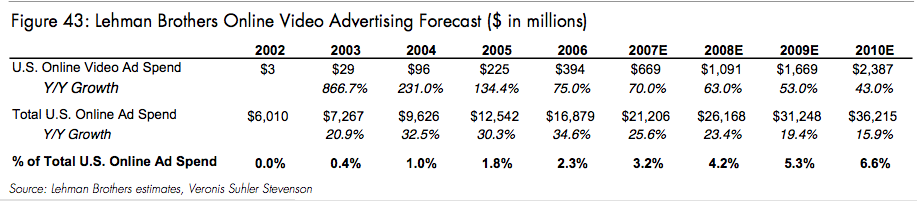
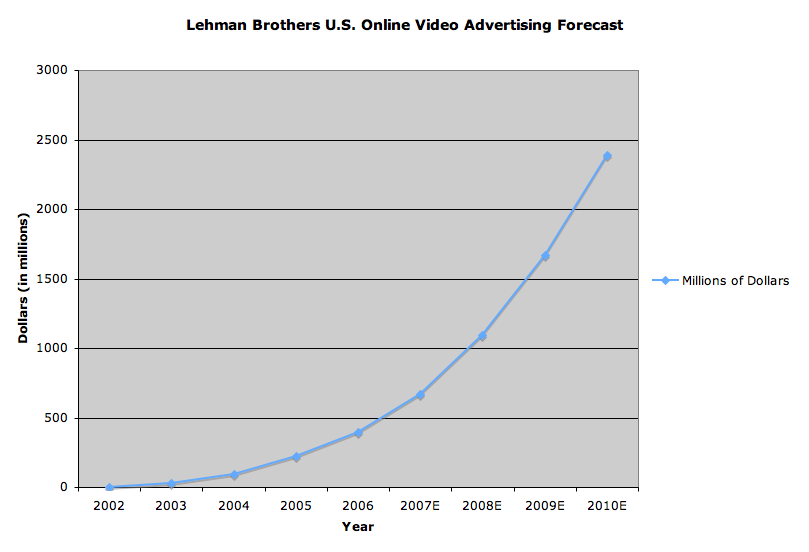
Video ads are the hottest area of growth. Analyst Doug Anmuth thinks
that online video ad spending will reach $1.1 billion this year (up 63
percent), and more than double to $2.4 billion over the next two years.


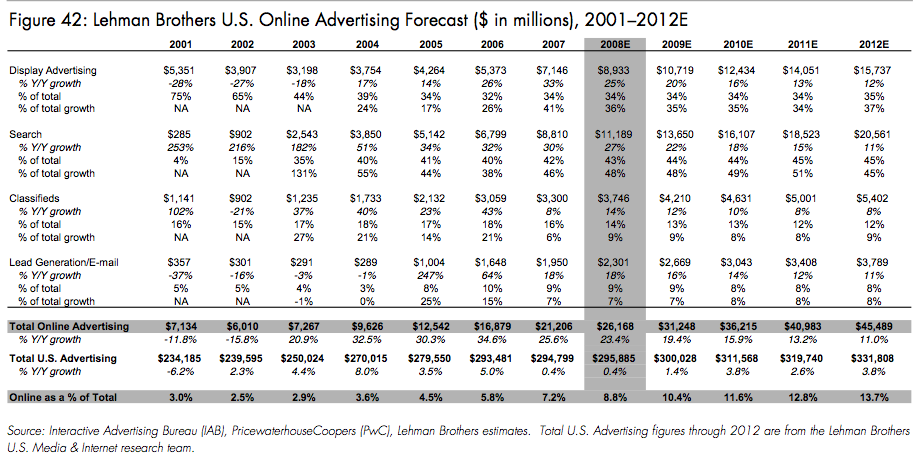
He also thinks that total advertising spending in the U.S. will go
from $26.1 billion this year to $45.5 billion in 2012 (consequently
increasing from 8.8 percent of total advertising spending to 13.7
percent).


Here are some tables with his estimates:


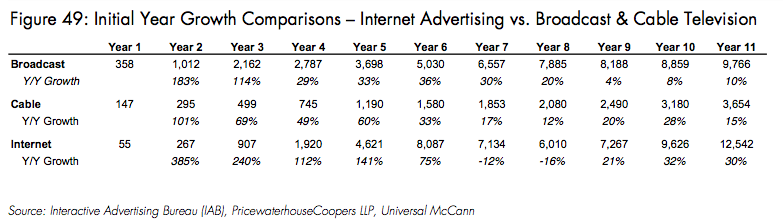
Also, to give some perspective on where online advertising is
compared to TV advertising, he offers this comparison chart of the
first decade of broadcast TV advertising VS. cable TV advertising Vs.
Internet Advertising. The 30 percent growth rate for Internet
advertising is double the rate of where cable advertising was at the
same point in its history, and triple the rate of broadcast TV
advertising. There, don’t you feel better already?


Article Link

Y Combinator To Offer Standardized Funding Legal Docs

Early stage venture firm Y Combinator,
which has funded over 102 young startups, has “open sourced” the legal
documents that they provide to their startups to use as they seek
additional funding beyond what they’ve gotten from Y Combinator. The
documents were created with their law firm, Wilson Sonsini Goodrich
& Rosati and are available here.

The goal, says Y Combinator cofounder Paul Graham,
is to help young startups avoid at least some of the legal costs
associated with that first round of financing. The lawyering fees don’t
vary much based on the size of the round, and so a significant portion
of small rounds can go directly to the lawyers on the deal. Companies
are routinely forced to pay the legal bills of the investors, too,
making the situation worse.


Jeff Clavier, the founder of early stage fund SoftTechVC, told me yesterday that the average legal bills on a deal are $20-$30k. Other angel investors gave estimates in the same range.


The Y Combinator documents are designed to have “terms close to neutral, in the sense that

they favor neither the investor nor the startup,” said Graham in an email.


We’re hoping that this will cause there to be a lot more
startups. I know (because for many years I was one) that there are a
lot of rich technology people who would do angel investing but don’t
because it seems like a schlep. And obviously there are lots of
startups desperate for funding. We’re hoping this document will bring a
lot more of them together.


Is Y Combinator helping their competitors by making the legal process easier? Absolutely. And Graham doesn’t seem to mind.


On a related note, earlier this year TheFunded started allowing entrepreneurs to publish the various term sheet clauses that venture capitalists were asking for.

Article Link

Monday, August 11, 2008

How to Demo your Startup

1.Show product in first 60 sec
2.The best products take less than five minutes to demo
3.Leave people wanting more
4.Talk about what you've done, not what you're going to do
5.Understand your competitive landscape -current and historical
6.Short answers are best
7.Powerpoint bullet slides are death
8.How to use this device call the phone
9.How to handle questions you don't know the to
10. Always confirm the time of your meeting/call, and always be 15 minutes early
Article Link

Monday, August 4, 2008

MySpace Banks On ‘Hypertargeting,’ But Plain Targeted Ads Continue To Suffice

Although MySpace continues to maintain that its hypertargeting
solution will ultimately lead to higher revenues, significant hurdles
remain. A day before the Fox Interactive Media unit’s parent News Corp (NYSE: NWS). releases its Q2 earnings, WSJ outlines the challenges to greater ad spending on MySpace.


-- Engagement: While there’s little question that users of
social net sites like MySpace and its rivals are engaged while they’re
on the site, it is uncertain whether they are too focused on changing
their profile pages and sending messages to friends to pay attention to
ads. And so, basic targeting placements are considered perfectly
adequate for media buyers and their clients’ needs.


-- Privacy: The rumblings from the Federal Trade Commission,
Congress, state lawmakers and digital rights advocates have spooked
some advertisers who don’t want their marketing efforts to turn into an
embarrassing footnote in a legal case. While there wasn’t much backlash
against participants in Facebook’s Beacon ad targeting program last
fall, the initiative still has many marketers and agencies wary of
being associated with the kind of negative publicity it drew.


-- Looking long-term: While FIM has touted the importance of
hypertargeting, executives are taking care not to talk it up too much.
Keeping investors in mind, the company often highlights its $900
million, three-year deal with Google (NSDQ: GOOG)
for featuring sponsored links on MySpace. And ads that take over the
site’s home page are also a source of value. Executives also argue that
the hypertargeting program is beyond being able to charge high ad
rates. Placing the emphasis on the long-term benefits for advertisers
who use the program over time, by offering broader insights into
consumers’ offline behavior beyond the basic targeting on the site.

Article Link

Monday, July 14, 2008

Text Messaging Huge with Young Adults

Text messaging is especially popular with US adults ages 18 to 34, according to Universal McCann's 2008 "Media in Mind" study. Respondents from that age group sent an average of 13 text messages every week.

In last year's survey, nearly one-half of all US adults said
they had never sent a text message. This year only 41% said so. Among
18 to 34 year-olds surveyed this year, just 22% had never sent a text
message, down from the 38% the prior year.

Need data for presentations? eMarketer subscribers can
download charts instantly — over 50,000 choices.

Request Info


"The great unwashed—those people who have never sent a
text message—is getting smaller all the time," said Graeme
Hutton, senior vice president at Universal McCann, in a MediaPost article.

Number of Text Messages Sent per Week according to US Adults, by Age, 2008


Text messaging is still new for many marketers, as evidenced by a February 2008 ExactTarget
study. The proportion of Internet users surveyed who owned a mobile
phone and had made a purchase after receiving a text message was a
paltry 6%. That percentage was higher among younger users, but still
mostly in the single digits.

Such low numbers could be interpreted to mean that text
messages are not a very effective way to market, but they might also
just reflect that such marketing is still relatively rare.

US Internet Users Who Have Purchased due to Receiving Marketing Messages, by Age and Channel, February 2008 (% of respondents in each group)


A December 2007 BIGresearch
study of US Internet users found similarly low text message influence:
6.4% of respondents said they had bought electronics because of text
messages, and still fewer said they had influenced purchases of other
types of goods.

US Adult Internet Users Whose Purchases Are Influenced by Mobile Phone Text Messaging or Video, by Product or Service Category, December 2007 (% of respondents)


If mobile marketing is to move beyond the experimental budget stage,
text messaging is likely to be part of the mix, in part since the
messages lend themselves to existing terminology and benchmarks,
according to John du Pre Gauntt, senior analyst at eMarketer.

"Mobile messaging is tailor-made for getting mobile marketing past the
early adopter stage and into the mainstream," Mr. Gauntt said. "Messaging has a clear currency—that is, messages
sent, received, opened or acted upon—for all parts of the mobile
marketing chain to use."

The eMarketer Mobile Music report will be published this month. Click here to be notified when it is released.

Article Link

Thursday, July 10, 2008

MSFT’s acquisition of Powerset is not about search

The recent $100 million acquisition of Powerset,
the semantic search engine company, by Microsoft looks to be more to do
with advertising than beefing up the software giants’ search
capabilities.


So far, Powerset has only demonstrated its technology against
Wikipedia. It’s a neat exhibit but it is highly computer intensive. You
would need a massive amount of computer power to run that semantic
search technology across the entire Internet.


Also, how many searches would benefit from a semantic component? Not many. Most searches are fairly direct in my experience.


Where Powerset’s technology could prove its usefulness is in
contextual advertising. That’s a much smaller semantic problem to
handle, and it is a semantic problem that would result in the largest
payoff.


The reason Yahoo is outsourcing some of its advertising to Google is
that GOOG is better at contextual advertising in than Yahoo. GOOG can
monetise those searches better than anybody else–at least for now.


If Microsoft can improve contextual advertising then maybe it can
win that type of business from Yahoo and others. If advertisers through
MSFT get better conversions than through Google then Microsoft wins,
imho.

Article Link